

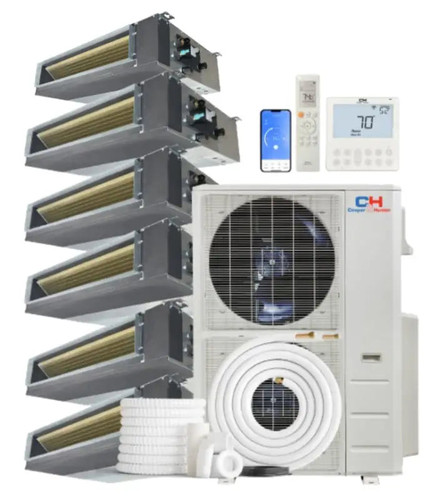
Cooper & Hunter 6 Zone 60,000 BTU Concealed Duct Mini Split AC R454B 6K+9K+12K+12K+12K+12K
Our price starting as
$9,549.00
 Shop by BTUFind the right capacity

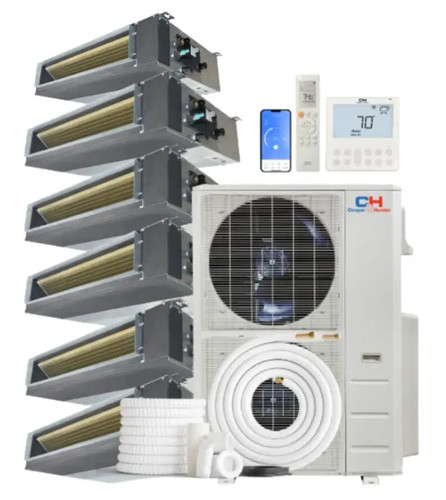

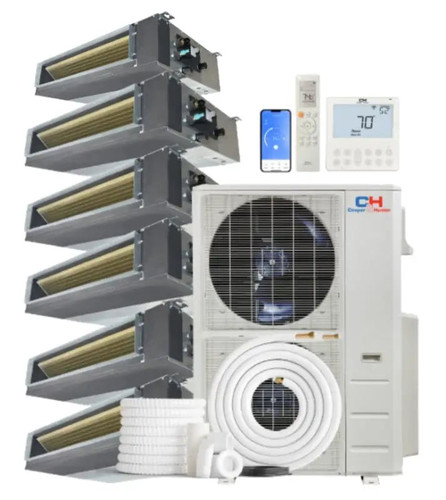
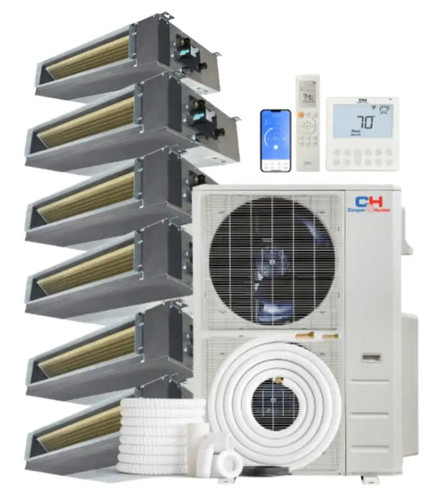


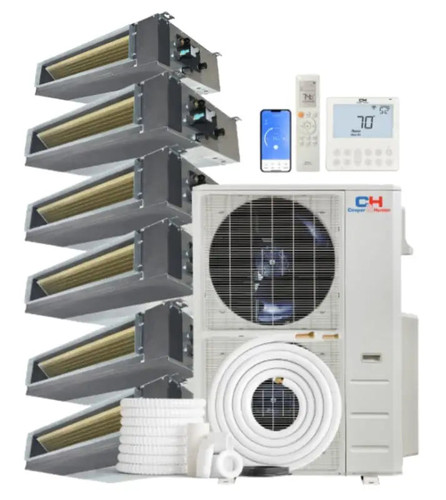


The era of the central thermostat—a singular dictator for a home of diverse thermal needs—is effectively over.
For decades, American homeowners have accepted the inefficiency of cooling empty guest rooms just to make the master suite bearable, or the architectural violence of forcing bulky ductwork into historic renovations.
Ductless mini split systems represent a shift from brute force to surgical precision.
Whether you are retrofitting a 1920s Craftsman, climate-proofing a glass-walled ADU, or demanding server-grade cooling for a home office, the solution is no longer about "buying an AC." It is about engineering a zonal atmosphere. This is not a catalog; this is a logic-based configuration engine. By following the steps below, you will bypass decision paralysis and construct a system that balances British Thermal Unit (BTU) loads, SEER2 efficiency ratings, and architectural preservation.
Don't just count rooms; map your lifestyle. The primary error buyers make is assuming a 1:1 ratio between rooms and units. Effective zoning partitions the home based on usage patterns and solar exposure.
(Single-Zone)
Ideal for "island" spaces disconnected from the main thermal envelope—garages, server rooms, or room additions. Here, the unit operates in isolation, reacting solely to the load of that specific enclosure.
(2–5 Zones)
This is the sweet spot for most residential retrofits. You separate the "Day Zone" (Kitchen, Living, Dining) from the "Night Zone" (Bedrooms). By leveraging multi-zone inverter technology, the outdoor unit ramps down energy consumption when only one zone is active, preventing energy waste.
(6+ Zones)
For whole-home replacements, we approach the territory of Variable Refrigerant Flow (VRF). This replaces central air entirely, eliminating duct loss (which accounts for up to 30% of energy consumption in traditional systems) and granting total sovereignty over every square foot.
Guessing your BTU requirement is a financial risk. Under-sizing leaves you sweating during a July heatwave; over-sizing is arguably worse. An oversized unit will cool the air too quickly and shut off before it has successfully dehumidified the space. The result? A cold, clammy room and a compressor that dies prematurely from rapid cycling.
Note that non-standard spaces behave differently. A 500-square-foot garage with concrete floors and no insulation requires significantly higher capacity—often 18,000 to 24,000 BTUs—compared to a 500-square-foot insulated living room, which might only need 12,000 BTUs. Concrete acts as a thermal battery, holding heat long after the sun goes down.
Use our integrated System Builder to input your specific parameters. We prioritize thermal load data over square footage rules of thumb.
Mini split form factors refer to the physical style of the indoor air handler. While wall-mounted units are standard, options include ceiling cassettes (flush-mount), floor consoles (radiator style), and concealed ducts (hidden), all of which can be intermixed on a single multi-zone condenser.
Your HVAC system should serve your interior design, not compete with it.
The standard for efficiency and airflow throw. Best for high-traffic areas where function trumps form.
The choice for open concepts. By recessing the mechanics into the ceiling joists, you reclaim wall space for art or cabinetry. 4-way airflow cassettes ensure even distribution without the "draft" effect of wall units.
The invisible solution. These units sit entirely behind a bulkhead or in a crawlspace, feeding air through small, discreet grilles. It offers the aesthetic of central air with the efficiency of a ductless inverter.
The problem solver. Perfect for attics with slanted ceilings or rooms with high windows where wall space is nonexistent. They emulate the physics of a radiator but provide active heating and cooling.
We are currently navigating a pivot in refrigerant technology. While R-410A has been the standard for decades, the industry is transitioning toward R-32 and R-454B. These next-generation refrigerants possess a lower Global Warming Potential (GWP) and higher thermal conductivity.
What does this mean for you? An R-32 system is not just "greener"; it is thermodynamically superior, often capable of carrying more heat energy with less mass flow. When building your system, consider R-32 for maximum future-proofing and efficiency, particularly in states with strict environmental codes like California or Washington.
Shipping a 300-pound condenser involves more than a cardboard box and a courier van. At HVACMart, we treat logistics as part of the product. Your system is palletized, shrink-wrapped, and strapped to ensure the copper connections and sensitive inverter boards arrive without trauma.
Do not overlook the "veins" of the system. Your order must include the correct length of line sets (insulated copper tubing), control wire (connecting indoor/outdoor comms), and a condensation drainage solution. Our builder logic automatically suggests compatible installation kits, ensuring you don't stall your contractor because of a missing drain hose adapter.